
SYMPIANO & Co.
The inside of a grand piano, as a reverb.
Sympathetic Resonance Works — est. 2026
AU · VST3 · Standalone — Apple Silicon & Intel — signed & notarized — genuinely free
What it is
Two hundred and thirty strings, listening to your music.
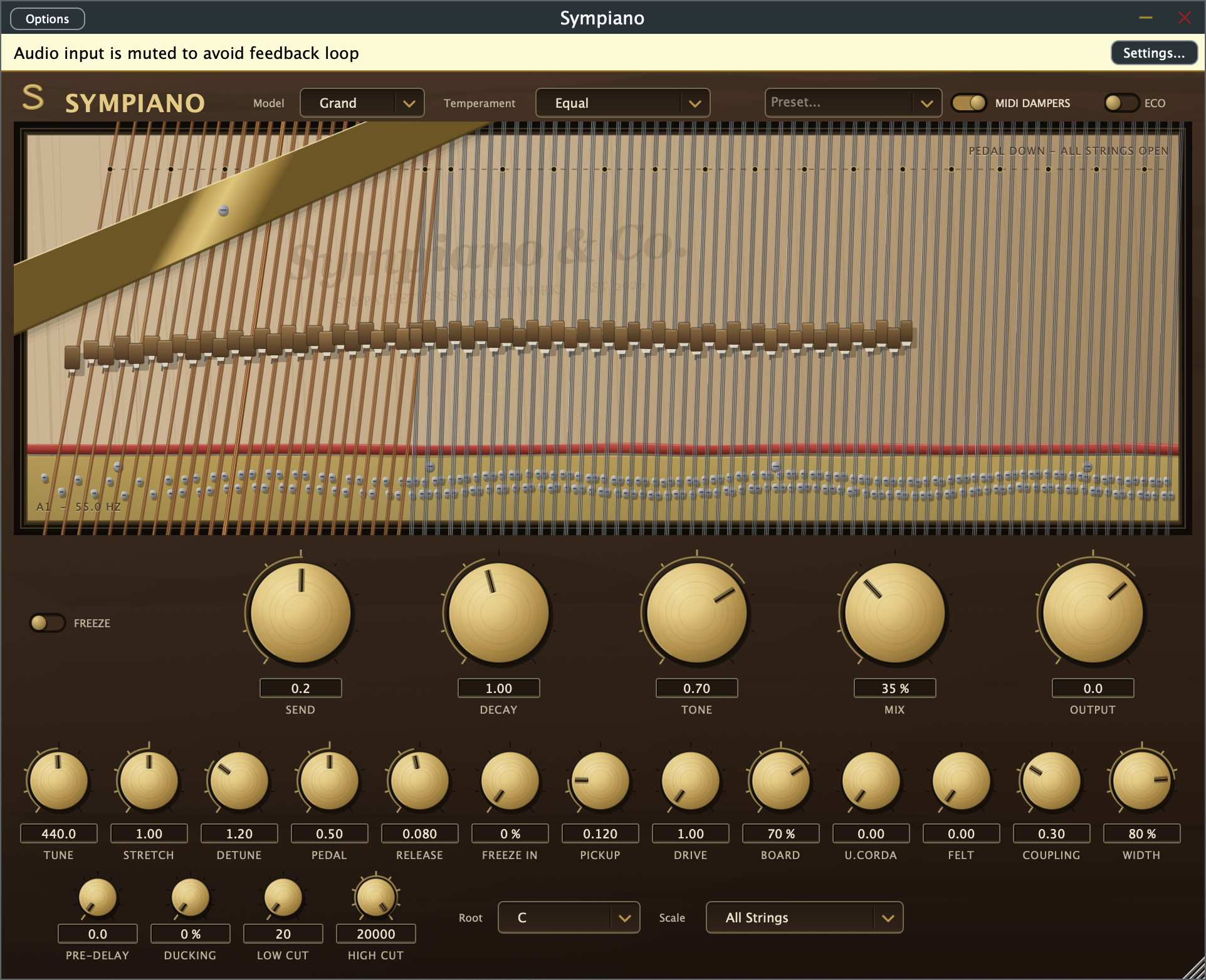
Hold the sustain pedal of a grand piano and sing into it: every string that shares a frequency with your voice hums back. Sympiano is that instrument, as a plugin — a physical model of all 230 strings of a grand (or upright), each one a tuned resonator with real inharmonicity, coupled at the bridge, damped by felt, and picked up by a virtual piezo you can slide along the string.
It is not a convolution of a piano. It is the piano — strings, dampers, pedal and all — resonating with whatever you feed it.
The listening room
Hear the strings bloom.
Real instruments, played into the strings — pedal down, dampers up.
The mechanism
What the knobs are attached to.
MIDI dampers
Route MIDI at it and only the strings you hold resonate. The sustain pedal works — including half-pedalling — and the top octaves stay open, damper-free, exactly like the real instrument.
Scale-aware resonance
No MIDI? Choose a root and one of 21 scales — from Ionian to Altered to Bebop — and only in-key strings ring. A reverb that always lands in the key of your track.
A movable piezo
Slide the pickup along the strings: near the bridge for glassy close-mic bite, at the halfway point to hollow out every even partial. It is physics, not EQ.
Freeze
Lock the strings at zero loss and the current resonance hangs forever — an instant tuned pad. Feed it new audio while frozen, or let it stand.
Grand & upright
Two physically distinct instruments: string lengths, stiffness, decay and the overstrung bass crossing all change — the upright growls, the grand sings.
The standard kit
Pre-delay, ducking, wet low/high cut, unison detune from concert-fresh to saloon, stretch tuning, four temperaments, una corda, felt mute, stereo width.
Under the plate
For the technically curious.
Sympiano is not a convolution reverb and contains no samples or impulse responses. It is a real-time digital-waveguide physical model — the same family of techniques used to model instruments from first principles — solved live, every sample, for every string.
230 living strings
Each string is its own waveguide loop with Fletcher–Rossing inharmonicity fitted per register. Change the tuning and the physics follows — there is nothing pre-rendered to go stale.
The Weinreich aftersound
Unison strings are genuinely coupled at the bridge, so the famous two-stage piano decay and slow unison beating emerge from energy exchange — they are not chorus effects painted on top.
Practical or experimental
At low mix it is glue: a tuned, always-in-key sheen no algorithmic reverb produces. Pushed hard — freeze, max coupling, saloon detune, bridge-close pickup — it becomes a drone instrument, a resonant filter bank, a texture machine.
Light enough to spend freely
The whole instrument runs at roughly a tenth of one CPU core at 48 kHz, independent of buffer size down to 32 samples — fit for live use and for stacking across a session.
Physics all the way out
The pickup control is a real tap position on the string (its comb filtering falls out of the wave equation), half-pedalling morphs actual damper loss, and the top octaves ring free because real pianos have no dampers up there.
Engineered, then audited
Over a million automated assertions on tuning (±3 cents), decay times, stability and hostile-input handling — plus an independent security review — before version 1.0 shipped.
Particulars
Specifications.
| Formats | Audio Unit (MIDI-controlled effect), VST3, Standalone app |
| Minimum system | macOS 11.0 or later · Apple Silicon or Intel (universal binary) · any 64-bit AU or VST3 host, or the included standalone app · ~40 MB disk, ~100 MB RAM · MIDI input optional |
| Engine | 230 digital-waveguide strings · 88 unison groups · bridge-coupled · ~10% of one core at 48 kHz (Apple M-series), ~20% at 96 kHz · buffer-size independent down to 32 samples · Eco mode ~4% |
| Sample rates | 44.1 / 48 / 96 / 192 kHz |
| Price | Free. No account, no email, no dongle. |
| Privacy | The plugin makes one optional, anonymous version-check request per day to this site. It can be turned off in the plugin. Nothing else ever leaves your machine. |
| In Logic | Find Sympiano under MIDI-controlled Effects on an instrument track; feed it audio via the side-chain picker. Full guide in the download. |